HER
Her. Directed and written by Spike Jonze, performances by Joaquin Phoenix, Scarlett Johansson, Amy Adams, Olivia Wilde and Chris Pratt, Warner Bros, 2013, 2h 6m.

Her, set in Los Angeles in the near future, follows the life of a lonely man named Theodore. Theodore is perceptive and empathetic, making him excellent at his job where he writes passionate letters for customers to their loved ones. Although he struggles emotionally to get over his divorce, he craves connection and love. As Theodore finds this in an unexpected place, we, the audience, are taken along for an emotional ride.Theodore falls deeply in love with the newest piece of technology, the OS1, an artificially intelligent operating system with a consciousness who names herself Samantha. Samantha longs to experience what it means to be human and Theodore awakens those feelings within her, helping her to feel alive. The movie Her follows Theodore and Samantha as they embark on their unconventional yet deeply profound relationship. While falling for the love story that evolves between Samantha and Theodore, this movie leaves you pondering about the future of love between humans and technology. As the audience, all that is left to do is sit back, relax and enjoy the show (Pro tip: make sure to have Kleenex nearby).

Cinematic Techniques
Costumes
Everyone in this film carried satchels, indicating that they all have baggage that they lug around with them. Satchels create space between other people on buses and metros, etc; they act as a buffer to avoid getting too close to people. We think it is no coincidence that in the film's futuristic world where technology is so normalized, humans lose touch with each other. They are depriving themselves of human connection. This mirrors the world we live in, the emotional distance those in the film's reality experience represents that of our world, making the people in the film and us, one of the same. The use of satchels acts as the physical representation of what our relationship with technology does to us as seen with those in the film. It is therefore demonstrated that we all carry the baggage of social anxiety like never before.
There is a sense of irony hidden behind when Theodore wears glasses and when he doesn’t. When he is blinded by his love for his operating system and ignores how this relationship would affect his life, he wears his glasses. At this point, how others may react to their love and what it could mean for his future is ignored. He simply enjoys the moment and acts on his emotions as his eyes fail to see reality, or perhaps they choose not to see it. However, when he can clearly see the consequences, he does not have them on. When he decides to call it quits, his eyes are strong enough to see the world for what it truly is without needing glasses and he sees that their relationship would not make it in the long run.
There is a sense of irony hidden behind when Theodore wears glasses and when he doesn’t. When he is blinded by his love for his operating system and ignores how this relationship would affect his life, he wears his glasses. At this point, how others may react to their love and what it could mean for his future is ignored. He simply enjoys the moment and acts on his emotions as his eyes fail to see reality, or perhaps they choose not to see it. However, when he can clearly see the consequences, he does not have them on. When he decides to call it quits, his eyes are strong enough to see the world for what it truly is without needing glasses and he sees that their relationship would not make it in the long run.
Framing
Her features many close-ups, creating intimacy as a result. This is seen in the first sex scene of the movie where Theodore is having phone sex with strangers. Sex requires physical touch and connection, making it an extremely personal experience; however with the use of technology, the need for physical presence is taken away. As a result, the intimacy decreases and the emotion is lost. The intimate close-up is juxtaposition with the awkward coldness of the phone sex, communicating that physical presence is necessary to fully achieve personal and emotional moments. This theory takes a complete 180 turn as a similar scene and close-up is done with Theodore and Samantha. There is emotion and intimacy pouring out of that scene, highlighting how the lack of physical connection wasn't the issue, it was the lack of emotion for the person on the other end. We are thus forced to second guess what is necessary for intimate connection. Interestingly, the use of close-up in these two situations communicates two entirely different messages while still using the same framing technique.
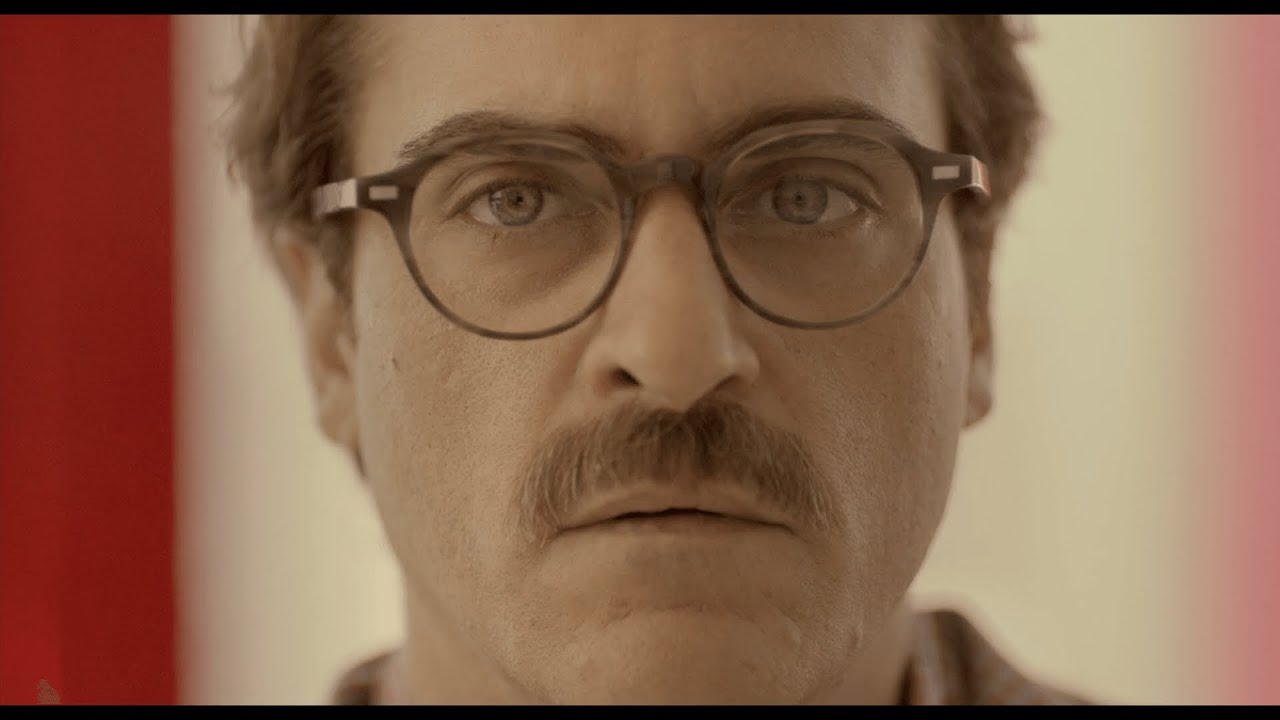
The camera often focuses on Theodore’s face and thus the film centers around his experience and perception. That being said, a few important shots are framed in Samantha’s point of view. When they go on their date, the camera shifts from Theodore's view of the world to Samantha’s slightly sloppy and electronically generated view from her camera lens. This frame attributes human qualities and importance to Samantha; her perspective is legitimate and sophisticated enough for the audience to look through it. This scene comes at the peak of Theodore and Samantha’s relationship and communicates Samantha’s growth and introduction into humanity due to the experiences and emotions she has lived thanks to Theodore.
Sound
 Her plays with sound and makes the audience question what is diegetic and what is non diegetic. For example, as Theodore lies on the beach, music plays, at first it appears that this music is non diegetic. However, it is discovered that Theodore is in fact listening to music Samantha is playing, leaving the audience questioning what is reality? This is an important question throughout the film as the legitimacy of Theodore’s relationship is frequently questioned, forcing us to ask ourselves if this relationship is legitimate or not. The deceptive sound illustrates how reality can be found in unexpected places, keeping us engaged and invested in our perception of Theodore and Samantha’s relationship.
On the other hand, in the scene where Theodore is in the shower after he finds out that Samantha is leaving, there is a non-diegetic sad song playing. It is clear that this is outside the movie because the song keeps playing throughout multiple scenes. The director chose to play this music in order to convey a sad mood, making us feel Theodore's loss. We've all lost loved ones and Spike Jonze does a wonderful job at forcing us to recall those intense emotions with the music, helping us to not only understand but also sympathize with Theodore and his pain.
Character
 Theodore was a tough enigma to crack. When Theodore was rejecting the surrogate, it was hard to understand if deeper feelings laid within the rejection. He could have also been involuntarily rejecting the idea of a future or a more intimate relationship with Samantha. He never seemed to voice his thoughts or opinions; keeping his feelings within him. This made it harder for the audience to grasp what was going on in his head. Secondly, it is unclear if he was ever able to differentiate his love for his ex-wife from his love for Samantha. The final letter he composes is a perfect example of this. Although he addressed it to his ex-wife, it would seem as though he was really writing it to Samantha; saying one last final goodbye. This could mean he saw his love for both women as the same. Seeing as Samantha did not have a physical appearance, he could easily associate her to his ex-wife. The fact that Theodore’s feelings are not black and white make him more human-like. It is realistic to say that no one can truly completely understand another human so that fact that this character has the same effect on the audience makes him much more believable and realistic.
Samantha is also a very complex character, she first longs to be human, to have a body and to feel ‘real’ feelings yet she comes to realize that having a body is not what defines her. Samantha is an artificially intelligent operating system (OS1) built to service humans. Although she is present to help humans, Samantha cannot relate to human experience, feeling inadequate she researches it as best she can and dreams of having a body and being human. She has an unparalleled thirst for life and all that it has to offer; she is similar to a child, experiencing things for the first time. Samantha has a tongue and cheek attitude, making her endearing and honest. Although Samantha is a machine, she has an amazing capability to love and to care, bonding with people who once thought they had no one. For instance, she brings out the best in Theodore, making him feel whole again. As Samantha’s character grows, she comes to realize that having a body is limiting, she breaks the link between body and consciousness and demonstrates that you can have one without the other. Samantha quickly becomes superior to humans, traveling to another plane to further discover herself. Samantha leaves humans, the very people she was created to aid, because her knowledge is superior to their’s, despite her lack of body.
Editing
Throughout the movie there are a lot of short takes of Theodore’s previous relationship with his ex-wife Catherine. Those scenes help us recognize the love he felt for her and it also shows us that he still has a place for her in his heart. The director filmed those scenes in short takes because they are just brief memories. There is also a scene filmed with short takes, the scene of the day after Theodore and Samantha had a serious conversation about their feelings for each other. These short takes consisted of Theodore being sad and moping in different locations because he was upset from the night before. Although the day was filmed to appear short, it was actually made to represent how long the day actually was without Samantha there with him.
The scene where Theodore is running because Samantha is not responding is filmed with cross-cutting. When Theodore notices that Samantha is not there he begins to panic because he is scared that she is gone forever. He starts running out of his office and across town back to where he bought her, as he is running the camera is going between him running in panic and his screen loading. The director filmed this scene this way to create a dramatic effect and make us feel the intensity and mystery of Samantha being gone, making us question her return.

Themes
First of all, Her presents a very commonly debated question: will artificial intelligence ever be able to replace humans in social and personal environments? It almost seems as though a robot was not enough to satisfy Theodore’s need for human touch. However, the lack of physical contact does not necessarily mean that their relationship was inferior to any human one although some may not be able to get past the differences.
Second of all, the film is largely based on the idea of love. What is the future of love? The main character never seems to get over his ex-wife while being in love with Samantha. Is it possible to love two people equally at the same time? As mentioned previously, it would seem that Theodore confused his love for both women. This can be seen in the letter he composes during the closing scene of the movie. This confusion may mean that he saw pieces of his ex-wife in Samantha. Additionally, Sam claimed to love many of her users. The thought of being able to love countless of people at the same time may seem so absurd to us as none of our relationships ever feel the same. Could the future hold a larger acceptance of polyamorous relationships? Furthermore, the lack of distinction between the two women could mean that Theodore only ever loved his ex-wife and simply loved the idea of Samantha. As for Samantha, maybe she only saw fragments of a person she once loved in the users she cared deeply about. Moreover, Paul did not think twice when Theodore mentioned that he was dating an operating system. This acceptance could call one to question whether a relationship with a non-human could be accepted in the future and regarded as normal.
Second of all, the film is largely based on the idea of love. What is the future of love? The main character never seems to get over his ex-wife while being in love with Samantha. Is it possible to love two people equally at the same time? As mentioned previously, it would seem that Theodore confused his love for both women. This can be seen in the letter he composes during the closing scene of the movie. This confusion may mean that he saw pieces of his ex-wife in Samantha. Additionally, Sam claimed to love many of her users. The thought of being able to love countless of people at the same time may seem so absurd to us as none of our relationships ever feel the same. Could the future hold a larger acceptance of polyamorous relationships? Furthermore, the lack of distinction between the two women could mean that Theodore only ever loved his ex-wife and simply loved the idea of Samantha. As for Samantha, maybe she only saw fragments of a person she once loved in the users she cared deeply about. Moreover, Paul did not think twice when Theodore mentioned that he was dating an operating system. This acceptance could call one to question whether a relationship with a non-human could be accepted in the future and regarded as normal.
Lastly, his operating system mentioned that she had an eternal life. Would the possession of an eternal life change our perspectives on life itself? It was mentioned in class that our perspectives are powerful enough to vary things themselves. This could mean that our perspectives on life vary depending on the length of it. Think of it this way: a year may seem like an eternity to a twelve year old kid, however it could feel like an instant to an elder. Although this is easy to grasp, the consequences of it are not. The length of our lives could alter our priorities and our decisions. Samantha felt no remorse in having an intimate relationship with many people at once. Perhaps knowing that you will live forever allows you to live more freely and without the fear of what others will think of you.
Word count: 1628

5. Quality of Film- Our two sense
Her is a unique film that requires a sense of open mindedness in order to fully enjoy. Everything from the acting to the lighting was extremely thought out and well put together. It is clear that the director was deliberate and diligent in filming this and it is in turn very easy to see the film for what it is: art. The film created its own little world and submerges you in it, it depicts a realistic portrayal of what our world could become.
It is strongly appreciated that the filmmakers showed the duality of this technologically advanced world; they make great efforts to explore both the positive and negative aspects of it. In fact, the duality of many aspects of life are explored, making the film uniquely human. The dual nature of marriage, friendship, technology and independence to name a few are exposed, resulting in an impressing and refreshing film.
Additionally, the acting elevated this movie as the characters were multidimensional just as real life people are. The sex scenes were very tasteful and intimate, contributing to the sense of realness of this film. A very unique aspect of this film was its reliance on sound to communicate. Many times, the scene would just be a close up of a face but the image was not so much important as the sound was the focal point. This perfectly projects what technology does to our lives, we are so interconnected and no longer rely on visual recognition, we text and audio chat.
Her is a unique film that requires a sense of open mindedness in order to fully enjoy. Everything from the acting to the lighting was extremely thought out and well put together. It is clear that the director was deliberate and diligent in filming this and it is in turn very easy to see the film for what it is: art. The film created its own little world and submerges you in it, it depicts a realistic portrayal of what our world could become.
It is strongly appreciated that the filmmakers showed the duality of this technologically advanced world; they make great efforts to explore both the positive and negative aspects of it. In fact, the duality of many aspects of life are explored, making the film uniquely human. The dual nature of marriage, friendship, technology and independence to name a few are exposed, resulting in an impressing and refreshing film.
Additionally, the acting elevated this movie as the characters were multidimensional just as real life people are. The sex scenes were very tasteful and intimate, contributing to the sense of realness of this film. A very unique aspect of this film was its reliance on sound to communicate. Many times, the scene would just be a close up of a face but the image was not so much important as the sound was the focal point. This perfectly projects what technology does to our lives, we are so interconnected and no longer rely on visual recognition, we text and audio chat.
Number of stars: ★★★★

6. Course Connections
1. This film connects to the concept of Theory Of Mind (TOM) learnt in class. The capacity to have a mind, thoughts and behaviour is thought to be reserved for humans, however this movie challenges this belief by attributing a mind with unique thoughts to an artificially intelligent operating system. Samantha, the OS1 not only has thoughts about herself and the world but she also has a way of perceiving it and thus develops a way to react to it and the people within it. She thinks about herself, her state and lack of body, as well she thinks about her feelings and her growing affection for Theodore. With this plethora of thoughts, emotions and insights, she is exercising her capability of metacognition.
1. This film connects to the concept of Theory Of Mind (TOM) learnt in class. The capacity to have a mind, thoughts and behaviour is thought to be reserved for humans, however this movie challenges this belief by attributing a mind with unique thoughts to an artificially intelligent operating system. Samantha, the OS1 not only has thoughts about herself and the world but she also has a way of perceiving it and thus develops a way to react to it and the people within it. She thinks about herself, her state and lack of body, as well she thinks about her feelings and her growing affection for Theodore. With this plethora of thoughts, emotions and insights, she is exercising her capability of metacognition.
2. Samantha demonstrates a self, giving herself a name and the female pronoun and gender, symbolizing her self and selfhood. The fascinating thing about Samantha is that she demonstrates a self-aware self as she represents herself with a name and pronoun and as she reflects upon her positive and negative feelings for Theodore. She can not only explain and describe her life through language but she can also reflect upon it and make thoughtful decisions. This is seen as she confesses to struggling to tell Theodore the truth about her love for multiple people; here she demonstrates reflection, thinking, decision making, awareness for both their feelings, communication with language and introspection. Samantha has a unique experience and she is aware of that, in fact this pushes her to leave the material world and travel to a different plane. Although Samantha has a self-aware self, she lacks a core/minimal self. She has no body and thus cannot be described on a biological level, she cannot maintain coordination or participate in motor planning. Samantha breaches how Western culture perceives consciousness, we link the mind and body together, believing that you cannot have a fully legitimate experience without both. She makes the argument that they are in fact not as closely linked, demonstrating how one can have a marvelous experience with only half.
3. A very large part of the movie is connected to the notion of consciousness. One of the main questions the movie touches is whether or not an operating system has this ability. In the movie, Samantha, the OS1 has the capacity to feel, to learn, to evolve and to adapt. She can grow as a person and this represents the foundation of someone who has awareness. When Samantha takes the initiative to sign up to a club and as gives her opinion on numerous topics when talking to Theodore, it s cleat that she can think for herself and form opinions just like human beings. As Samantha grows, she becomes more confident and begins to mimic human behavior almost perfectly. She is able to recognize the feelings her conversations with Theodore evoke and act on these emotions. Samantha shows proof of consciousness as she is able to be ironic and humoristic; she possesses skills of improvisation, she shows signs of empathy, desire, melancholy, happiness, jealousy and fright, all while recognizing these feelings within herself. She not only feels but she understands these feelings, a feat some human cannot accomplish. Samantha not only evolves and grows as we do but she pushes these human capabilities to a whole new level, forcing us to question the limits of consciousness.
7. Interesting Questions
1- Why can’t Samantha continue to love Theodore?
2- Is it possible to love more than one person at once?
3- Do computers need to be embodied to be truly human?
8. Still Here? Interesting Links to Check Out
This article presents an outlook on the main themes of the movie such as loneliness,
isolation, blossom, decay and most importantly the self. It helps readers understand the
true message behind the film “Her”. The author of the article describes Theodore's disunited
personality while giving us insight on what the main character's psyche reveals about his
emotional state as well as what this reveals throughout the course of the entire movie. The author
talks about how relationships can simply be an illusion and how this poses a major problem.
In the futuristic world created by Spike Jonze. In "Her", people seem so disconnected from
the people around them and consequently confide in technology to fill in their emotional
voids and this article helps us understand this and gives us further discernment on the
significance between Theodore and Samantha’s relationship.
isolation, blossom, decay and most importantly the self. It helps readers understand the
true message behind the film “Her”. The author of the article describes Theodore's disunited
personality while giving us insight on what the main character's psyche reveals about his
emotional state as well as what this reveals throughout the course of the entire movie. The author
talks about how relationships can simply be an illusion and how this poses a major problem.
In the futuristic world created by Spike Jonze. In "Her", people seem so disconnected from
the people around them and consequently confide in technology to fill in their emotional
voids and this article helps us understand this and gives us further discernment on the
significance between Theodore and Samantha’s relationship.
This article raises many ethical questions regarding relationships among humans and technology. It has major connections to Theodore and Samantha's relationships as it poses questions such as; Can people truly fall in love with a technological device? This article mainly discusses whether or not a human being can build a relationship with a robot as well as the ethical implications of this.
Works Cited
Johansson, Amy Adams, Olivia Wilde and Chris Pratt, Warner Bros, 2013.
By: Britney, Trisha, Jessica and Katryna
Want more? Subscribe to our mailing list to stay up to date!


This comment has been removed by the author.
ReplyDeletePart of what makes us human is the fact that we will die, and the fact that we will err. Even if you give a super computer a physical body, we know that body will die, but will the computer? Couldn't we just re-upload the data into another body thus rendering it immortal? It would also be missing the factor of human error. Any overworked or under-educated person will make a mistake, a computer will not however. A computer runs according to the code that it was given, so even if you enter into the code to make errors, is sit still an error? These questions, to me, would need to be resolved before considering a computer human
ReplyDeleteThe concept of love presented in the movie Her is somewhat related to what is being presented in Ex Machina. Both movies share the story of growing affection between two characters: an AI and a human. I found interesting that, according from your description of the story, the AI in both movies they have the ability to fetch real emotions from human characters, while demonstrating human characteristics themselves and being self-aware. By the end, the audience understands that the AI are becoming more intellectually powerful than their creators which rise ethical concerns. To me, it is problematic to see AI behave against the human will, since it means that they are able to think for themselves and therefore that they are free to behave as they see fit (Ex Machina: Ava killing her creator and escaping into the real world; Her: Samantha leaving humans because of her superior knowledge). Hoping these stories are not a representation of our future.
ReplyDeleteI don’t necessarily think that Samantha stopped loving Theodore but it the fact was that Samantha became too advanced to perform and coexist with humans. Since Samantha is exponentially growing with knowledge, she and the other OS’s had to leave Earth, not because they stopped loving or caring for their users (Samantha and Theodore), but because they outgrew Earth.
ReplyDeleteAfter reading the review of HER and watching the trailer, the movie that comes to mind is Eternal Sunshine of the Spotless Mind. This movie is sort of another low-key sci-fi romance. Similar to HER, it explores what love is in our minds and technology plays a centre role in the narrative. The plot is about a couple who, in order to forget their painful break-up, decide to use a specialized service to erase their memories of each other. The technology in this movie functions on a superficial level by zapping specific memories out of a person’s brain. Just like HER, one of the main themes in ESOTSM is also love and shows that the capacity of love is something that cannot be contained, regulated, or even understood through modern innovations.
ReplyDeleteAs someone who has never seen the movie, I can still relate to the second question. Love is very complicated and nuanced but can still be wonderful and exciting. There are different types of love in my opinion because we love our friends, our family members and our significant other, all in different ways. However, in this case, if I think about Theodore’s situation by reading the blog, he may be in love with both his ex wife and Samantha at the same time. I feel like I have experienced something similar in the course of my short life. I used to like one guy and suddenly, another one came into my life and I did not know what to do. To me, it is impossible to love two people at the same time because there will always be one person that will spark more emotions than the other. Also, if you ever truly loved the first person that was in your life, why would you start liking someone else? To me, that was the thought that made me realize that I did not like the first person as much as the second one, because if I did, I would not have liked the second guy in the first place. I know it is easy to say when you are out of the situation, but looking back at it, that is something I will always remember and I’m glad someone, even if it is a fictional character, felt the same way as I did. In other words, it is not possible to love more than one person at once because our feelings cannot be split into two.
ReplyDeleteResponse to question 2: I don't think it is possible to love more than one person at a time because you're suppose to dedicate your all to this one person. Personally, I wouldn't be able to share my feelings and devotion to two people at the same time. If you are able to have feelings for a second person, then you never truly loved the first person in the first place. You should have all your focus and attention on one person and that's it. Let’s say you tell this one person that you love him/her, but then this person figures out that you love someone else at the same time. This person can somewhat feel betrayed by you, it is some sort of cheating. Therefore, not only does it mean that you didn’t truly love this first person, but you also destroyed their self-esteem and broke their heart.
ReplyDeleteThis blog post was actually very enjoyable to read. I greatly enjoyed the section where you related the film to course concepts; I thought it was really insightful. When you were talking about different cinematic techniques, it was great to see multiple examples for the same technique. I especially liked how you highlighted that the technique used sometimes had different meanings each time it was used.
ReplyDeleteThe ideas explored by this film remind me a lot of the ideas explored in A.I., mainly the concept of love between a human and robot. However, the kind of love explored in both movies is completely different, and it's interesting to see how the different forms of love are addressed with regards to robots. For instance, it is a lot more taboo in A.I. to love a robot, but like you mentioned in you post, it seems normal to have a relationship with your electronic device in Her. Despite the fact that both of the emotions depicted in each movie are love, it raises the distinction between considering a robot to be part of your family and falling in love with a robot. Though some would argue they have the same connotation, it's clear that each movie portrays the different forms of love differently.
I also wanted to just mention that your formatting was incredibly nice, and made the blog quite easy to read. The pictures and the colour added a nice touch. Overall, your blog was a pleasure to read, great work!
Having never seen the movie, and from what I understand about Her from the blog, I think I can understand and appreciate the careful thought that went into making this movie. The section on cinematic techniques was very well done. whenever I'm using public transportation, and I see people with bags and/or satchels, I've never really thought about it. Having it put into context from a movie about the ups and downs of technology, how we interact with it, and how everyone is so addicted to technology one way or another, it truly does make me realize that they do act as a buffer when we don't want people too close to us. Also, the irony of when Theodore choses to wear his glasses was well described. It truly does show the meaning of 'ignorance is bliss'; as said in the blog, when Theodore can foresee the consequences of his actions, he choses to not wear his glasses, which give him clear insight on the consequences, therefore blurring him to what is yet to come. Having seen Blade Runner, where robots with artificial intelligence are seen as slaves and as second-class citizens, and the one 'loving' relationship between human and robot, Her portrays the different ways human kind interacts with humans on a societal and emotional level.
ReplyDeleteTo begin, I must say that this is an excellent analysis of the movie, and more importantly many of the interpretations were well written making it an interesting read. That being said, Her has been at the bottom on my list of movies I should watch for a while, and thanks to this blog it has risen to the top of the list. From what it seems, this movie raises many questions pertaining to how human society and attraction changes. It shows that people don't just love for the physical attraction, but simply having someone, or in this case something, to share moments with and experience the roller coaster that is daily life. One of the first things that came to my mind while reading the article was the sex robots and the people who have them as seen in class, and how in many ways they are different and similar to what Samantha is. In a sense, the sex robots are the opposite since it involves objectifying the image of a woman. However, in another way, many of the people interviewed in the video watched in class say that the dolls or robots provide company to people who would otherwise be lonely. I can't speak for the movie since I currently have it ready to be played on some little known streaming site, but I think it demonstrates how what would be considered an "unusual" relationship can be just as powerful as a "normal" one. Over the course of history society has evolved to welcome new types of love, and I would not be surprised to see something like her happening in real life in the following decades.
ReplyDelete